


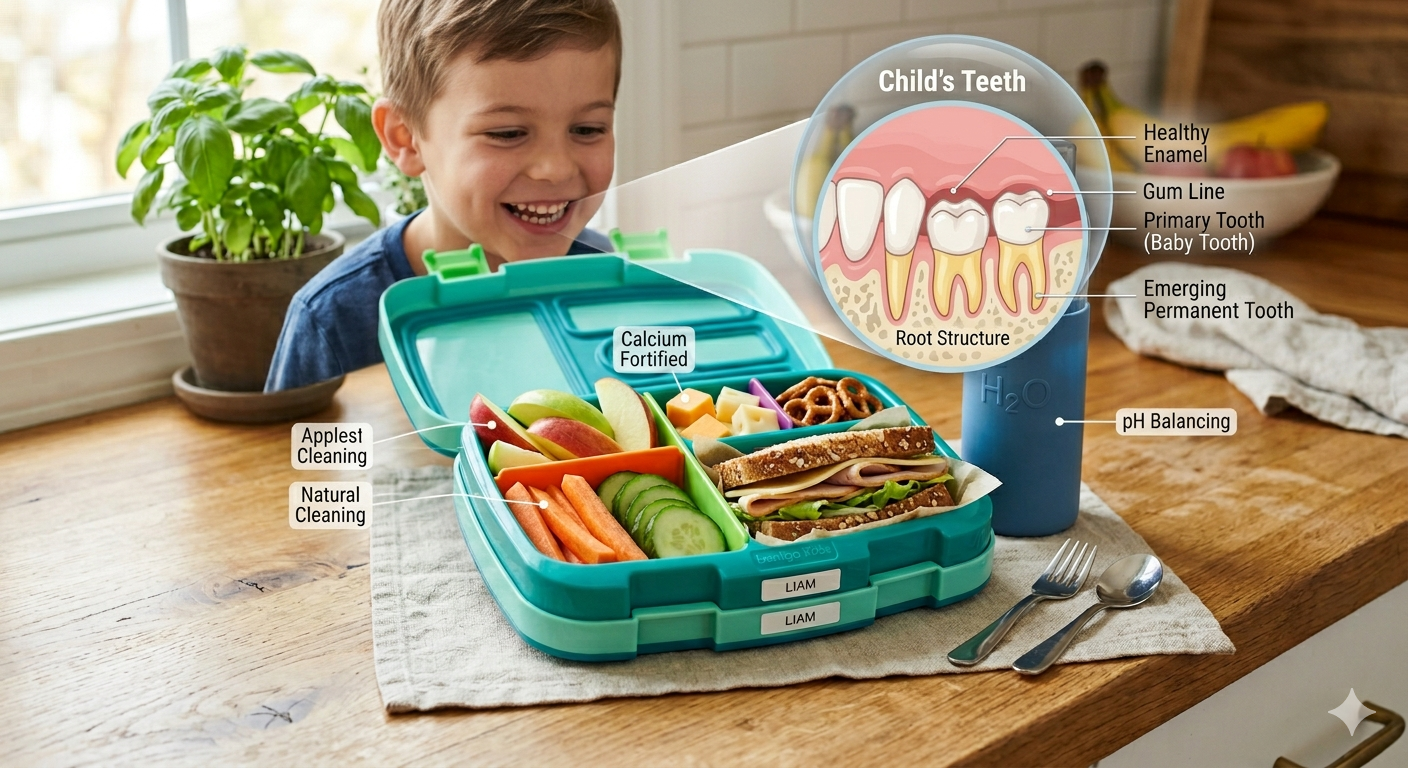
Every parent wants to do right by their child at lunchtime. You pack the bag, zip it up, and send it off — hoping it gets eaten and not traded for someone else’s chips. But beyond keeping your child full and energized through the afternoon, what goes into that lunchbox has a direct and measurable impact on the health of your child’s teeth. The foods children eat throughout the school day either feed the bacteria that cause decay or actively work to protect and strengthen enamel. Understanding which is which changes everything about how you approach the daily lunch routine.
This guide is written for every family — parents of infants taking their first steps toward solid foods, parents of school-age children packing their fifth lunchbox of the week, and parents of teens who have more say than ever in what they eat. It is also written with multilingual and multicultural families in mind, because the foods that protect your child’s teeth are not limited to any single cuisine. A diverse, whole-food diet is one of the strongest foundations for lifelong oral health, and your cultural food traditions absolutely have a place in a tooth-friendly lunchbox.
A Guide to Preparing Oral-Health Friendly School Lunches
Building a school lunch that supports your child’s teeth starts with understanding what actually damages them. The two primary threats to a child’s teeth during the school day are sugar and acid. Sugar feeds Streptococcus mutans and other cavity-causing bacteria that live in the mouth, producing acid as a metabolic byproduct. That acid then dissolves tooth enamel — the hard outer layer that protects your child’s teeth. Acid from dietary sources, such as fruit juices, sodas, and sour snacks, works by the same mechanism but without the bacterial middleman.
The frequency of sugar and acid exposure matters as much as the quantity. A child who sips a juice box slowly over forty-five minutes exposes their child’s teeth to acid continuously throughout that window. A child who drinks the same juice box in five minutes at lunch gives their saliva time to neutralize the acid before the next food or drink arrives. This is why grazing habits — snacking or sipping throughout the day rather than eating at defined meal times — are particularly damaging to a child’s teeth.
The Lunchbox Framework for Protecting a Child’s Teeth
When building an oral-health friendly school lunch, think in four categories:
- A protein source that is low in added sugar and does not stick to tooth surfaces (chicken, hard-boiled eggs, hummus, cheese, unsweetened nut or seed butter).
- A crunchy vegetable or fruit that stimulates saliva and mechanically cleans tooth surfaces (carrot sticks, celery, cucumber, apple slices, pear).
- A calcium-rich component that remineralizes enamel (plain yogurt, cheese cubes, milk, fortified plant-based milk, edamame).
- Water as the primary drink, ideally fluoridated tap water, which hydrates, supports saliva flow, and delivers ongoing remineralization support to your child’s teeth.
When a lunch is built around these four pillars, it actively supports the structural integrity of your child’s teeth rather than working against it. This framework is flexible enough to accommodate nearly any cultural food tradition and any budget.
Analyzing the Relationship Between Nutrition and Oral Wellness
The science connecting nutrition to your child’s teeth is both well established and frequently underappreciated. Most parents understand that sugar causes cavities. Fewer understand that the specific nutrients in food have direct biological effects on the strength and resilience of a child’s teeth — effects that can either accelerate decay or actively resist it.
Nutrients That Build and Protect a Child’s Teeth
- Calcium and phosphorus: These two minerals are the primary structural components of tooth enamel and dentin. Adequate dietary calcium and phosphorus throughout childhood are essential for building strong, dense enamel that resists acid attack. Dairy products, beans, leafy greens, nuts, and seeds are rich sources available across virtually every food culture.
- Vitamin D: Often called the sunshine vitamin, vitamin D is essential for the absorption of calcium. Without adequate vitamin D, a child’s teeth cannot fully mineralize even when calcium intake is sufficient. Many children in the United States are deficient. Fatty fish, egg yolks, and fortified dairy and plant-based milks are good dietary sources.
- Vitamin C: Vitamin C is essential for the production of collagen, the protein matrix of gum tissue. Deficiency leads to weakened, bleeding gums and impaired healing. Fresh fruits and vegetables — even those that are mildly acidic, like bell peppers and strawberries — provide vitamin C without prolonged acid exposure when eaten as part of a meal rather than sipped.
- Fluoride: While not a nutrient in the traditional sense, fluoride from drinking water and toothpaste is the most evidence-supported agent for strengthening a child’s teeth against decay. Sending your child to school with a water bottle filled from the fluoridated tap provides ongoing passive fluoride exposure throughout the day.
- Fiber: High-fiber foods require significant chewing, which stimulates saliva production. Saliva is the mouth’s built-in defense against acid and decay, so foods that keep saliva flowing protect a child’s teeth between meals.
Nutrients and Foods That Harm a Child’s Teeth
Understanding what to avoid is equally important. The following are the most damaging dietary factors for a child’s teeth, especially in the context of school lunches:
- Added sugars in disguise: Many foods marketed to children as healthy — flavored yogurts, granola bars, fruit snacks, and juice pouches — contain as much added sugar as candy. Reading ingredient labels and looking for added sugars listed under names like high-fructose corn syrup, cane juice, dextrose, and maltose is essential for protecting a child’s teeth.
- Sticky and chewy foods: Foods that cling to tooth surfaces — dried fruit, fruit leather, chewy granola bars, gummy vitamins, and caramel — prolong sugar contact time dramatically. A piece of dried mango stuck in the grooves of a molar can continue feeding decay-causing bacteria for twenty minutes or more after eating.
- Acidic drinks: Fruit juice, sports drinks, flavored water, and carbonated beverages all lower the pH of the oral environment below the threshold at which enamel begins to dissolve. These drinks are particularly harmful to a child’s teeth when sipped slowly throughout the school day.
- Refined starchy snacks: Crackers, white bread, and pretzels break down rapidly into simple sugars in the mouth and stick between teeth. Parents are often surprised to learn that a handful of saltine crackers can be as harmful to a child’s teeth as a piece of candy.
The goal is not to eliminate all enjoyable foods from your child’s lunchbox. It is to understand the landscape and make choices that tip the balance in favor of protection rather than damage.
Beyond the Sandwich: Creative Ways to Pack a Cavity-Fighting Lunch
The standard American school lunch — a sandwich, a bag of chips, a juice box, and a cookie — is not doing your child’s teeth any favors. But moving away from this default does not require exotic ingredients or an hour of meal prep. It requires a shift in what you reach for automatically, and a few ideas to replace the items that consistently undermine a child’s teeth.
Tooth-Friendly Lunch Ideas by Category
Proteins That Support a Child’s Teeth
- Hard-boiled eggs with a pinch of salt — high in phosphorus and vitamin D, easy to prep in batches for the week
- Cubed or sliced cheese — alkaline pH helps neutralize oral acids immediately after eating, directly protecting a child’s teeth
- Plain hummus with vegetable dippers — provides plant-based protein and pairs with crunchy vegetables that mechanically clean a child’s teeth
- Rolled turkey or chicken slices — no bread needed, easy to eat, low in sugar
- Edamame in the shell — rich in calcium and protein, fun for younger children to pop open, a staple in many Asian family food traditions
Crunchy Produce That Cleans a Child’s Teeth Naturally
Firm, crunchy fruits and vegetables act as natural toothbrushes — their fibrous texture scrubs tooth surfaces as a child chews, while the chewing action itself stimulates saliva flow. The best choices include:
- Carrot sticks, celery, cucumber rounds, and bell pepper strips
- Apple slices — mildly acidic but high in water content and fiber, best eaten as part of a meal rather than alone
- Pear and jicama slices — excellent high-water, high-fiber options popular in many Latin American family lunchboxes
- Snap peas and broccoli florets with dip
Culturally Diverse Tooth-Friendly Options
For multilingual and multicultural families, the good news is that traditional whole-food ingredients from virtually every food culture are excellent for a child’s teeth. Rice and lentil dishes, whole-grain flatbreads with legume spreads, marinated grilled proteins, pickled vegetables (eaten at the end of a meal to avoid prolonged acid exposure), and fresh fruit-based sides all fit within a tooth-protective framework. What matters most is minimizing added sugars and avoiding sticky or syrupy preparations as primary lunchbox staples.
5 Simple Swaps for a More Nutritious Kid’s Lunchbox
You do not need to overhaul your child’s lunchbox overnight to meaningfully improve the protection it offers for your child’s teeth. These five targeted swaps address the most common lunchbox items that undermine oral health, replacing each with an alternative that is equally convenient, similarly kid-friendly, and substantially better for a child’s teeth.
Swap 1: Juice Box → Fluoridated Tap Water in a Reusable Bottle
This is the single highest-impact swap available for protecting a child’s teeth. A standard 4-ounce apple juice box contains approximately 12 grams of sugar and has a pH around 3.5 — acidic enough to begin dissolving enamel on contact. Replacing it with a reusable bottle of fluoridated tap water eliminates sugar and acid exposure entirely while providing continuous remineralization support throughout the school day. If your child resists plain water, try adding a few slices of cucumber or strawberry to the bottle for gentle natural flavor without acidity or sugar.
Swap 2: Fruit Snacks or Gummies → Fresh or Freeze-Dried Fruit
Fruit snacks and gummy treats are among the most damaging foods for a child’s teeth because they combine high sugar content with a sticky texture that clings to enamel for extended periods. Fresh fruit — grapes, blueberries, melon cubes, or clementine segments — provides natural sweetness, vitamins, and hydration without the adhesive quality. Freeze-dried fruit is a convenient, non-sticky alternative with a satisfying crunch that children tend to love.
Swap 3: Flavored Yogurt → Plain Yogurt with Toppings
Many flavored yogurts marketed specifically to children contain more added sugar per serving than a glazed donut. Plain whole-milk or Greek yogurt contains essentially no added sugar, is rich in calcium and phosphorus that support your child’s teeth, and can be made appealing with a small handful of berries or a drizzle of honey for older children. For babies and toddlers, plain yogurt mixed with pureed fruit is an excellent early introduction to foods that support a child’s teeth from the very first bites.
Swap 4: Chips or Crackers → Cheese and Vegetable Sticks
Refined starchy snacks like chips and crackers break down quickly into fermentable sugars and wedge between teeth in ways that are difficult to clear without brushing. Replacing them with cheese cubes and crunchy vegetable sticks provides a satisfying texture experience while actively supporting a child’s teeth. Cheese raises the pH of the mouth after eating, neutralizing the residual acid from other foods consumed at the same meal. Crunchy vegetables stimulate saliva and physically brush surfaces clean.
Swap 5: Store-Bought Sweetened Granola Bar → Whole-Grain Crackers with Nut Butter
Commercial granola bars, even those with health-oriented branding, frequently contain 10 to 20 grams of added sugar and are bound with syrups that stick aggressively to a child’s teeth. Whole-grain crackers paired with unsweetened almond or sunflower seed butter provide sustained energy, healthy fats, and fiber without the sugar load or adhesive quality. For children with nut allergies, sunflower seed butter is an excellent alternative available in most grocery stores and safe for school environments with nut-free policies.
For families looking for more personalized guidance on how diet affects their child’s teeth at different developmental stages, our team at Fayrouz Pediatrics provides comprehensive nutritional guidance as part of every pediatric dental evaluation. You can explore our full range of services, including our pediatric dentist treatment offerings, to find the right support for your child’s oral health needs.
Frequently Asked Questions About Healthy Lunches and a Child’s Teeth
How to pack a balanced lunch for kids?
A balanced lunch for kids covers the key nutritional bases while actively protecting a child’s teeth. Start with a lean protein source such as eggs, cheese, turkey, or legumes. Add a complex carbohydrate like whole-grain bread, brown rice, or whole-grain crackers. Include at least one serving of fresh vegetables and one of fresh fruit, chosen for their fiber and water content rather than their sweetness alone. Round it out with a calcium-rich component such as yogurt or a portion of milk, and always send water as the drink. Avoid added sugars, sticky textures, and highly acidic beverages. When every lunchbox category is addressed, you are feeding both your child’s body and their teeth well.
What to put in a healthy lunch box for kids?
A healthy lunchbox for kids that also protects a child’s teeth should include: a protein such as hard-boiled eggs, cheese, hummus, or sliced chicken; a crunchy vegetable like carrot sticks, snap peas, or bell pepper strips; a whole fruit or freeze-dried fruit rather than fruit snacks or juice; a whole-grain carbohydrate for sustained energy; plain yogurt or a small portion of milk for calcium; and a bottle of water rather than juice or a sports drink. Avoid including dried fruits, gummy snacks, flavored juice pouches, or high-sugar granola bars, as these are the lunchbox staples most damaging to a child’s teeth over time.
What is a good healthy lunch to pack for school?
A great school lunch that genuinely supports a child’s teeth might look like this: whole-grain crackers with sliced turkey and cheese, a container of carrot and cucumber sticks with hummus for dipping, a small bunch of grapes, a single-serve container of plain Greek yogurt, and a water bottle. This lunch covers protein, calcium, fiber, vitamins, and hydration — all without a single item that would harm a child’s teeth. It can be assembled in under ten minutes the night before and holds well without refrigeration in an insulated lunchbox. The key principle is that every item either helps or is neutral for your child’s teeth — nothing in the box is actively working against them.
What are 6 tips for packing a safe lunch?
Here are six practical tips that keep both food safety and your child’s teeth in mind when packing a school lunch:
- Use an insulated lunchbox with a cold pack to keep perishable foods like yogurt, eggs, and cheese below 40°F until lunchtime, preventing bacterial growth while preserving the calcium-rich foods that protect a child’s teeth.
- Pre-portion everything the night before to reduce morning rush decisions that default to convenience items high in sugar. A little planning protects both food safety and a child’s teeth.
- Avoid cross-contamination by packing items in separate sealed containers. Keeping dips, proteins, and produce separate also prevents soggy textures that reduce how much children actually eat.
- Always include water in a clearly labeled, leak-proof bottle. Water is not only safe but actively protective for a child’s teeth, making it the only drink worth sending to school every single day.
- Pack finishing foods last in the eating sequence. Foods like cheese, which raise oral pH after a meal, are most protective for a child’s teeth when eaten at the end of lunch rather than at the beginning.
- Teach children to rinse with water after eating if they cannot brush at school. Even a simple swish and swallow neutralizes residual food acids and provides immediate protection for a child’s teeth between the lunch bell and the end of the school day.
Every lunchbox is an opportunity. With a small shift in what you pack and why, the daily school lunch becomes one of the most consistent tools you have for protecting your child’s teeth from the inside out — one meal at a time.
Published by the clinical care team at Fayrouz Pediatrics — supporting healthy smiles for children at every stage of growth, from infants to teens, across all families in the United States
