


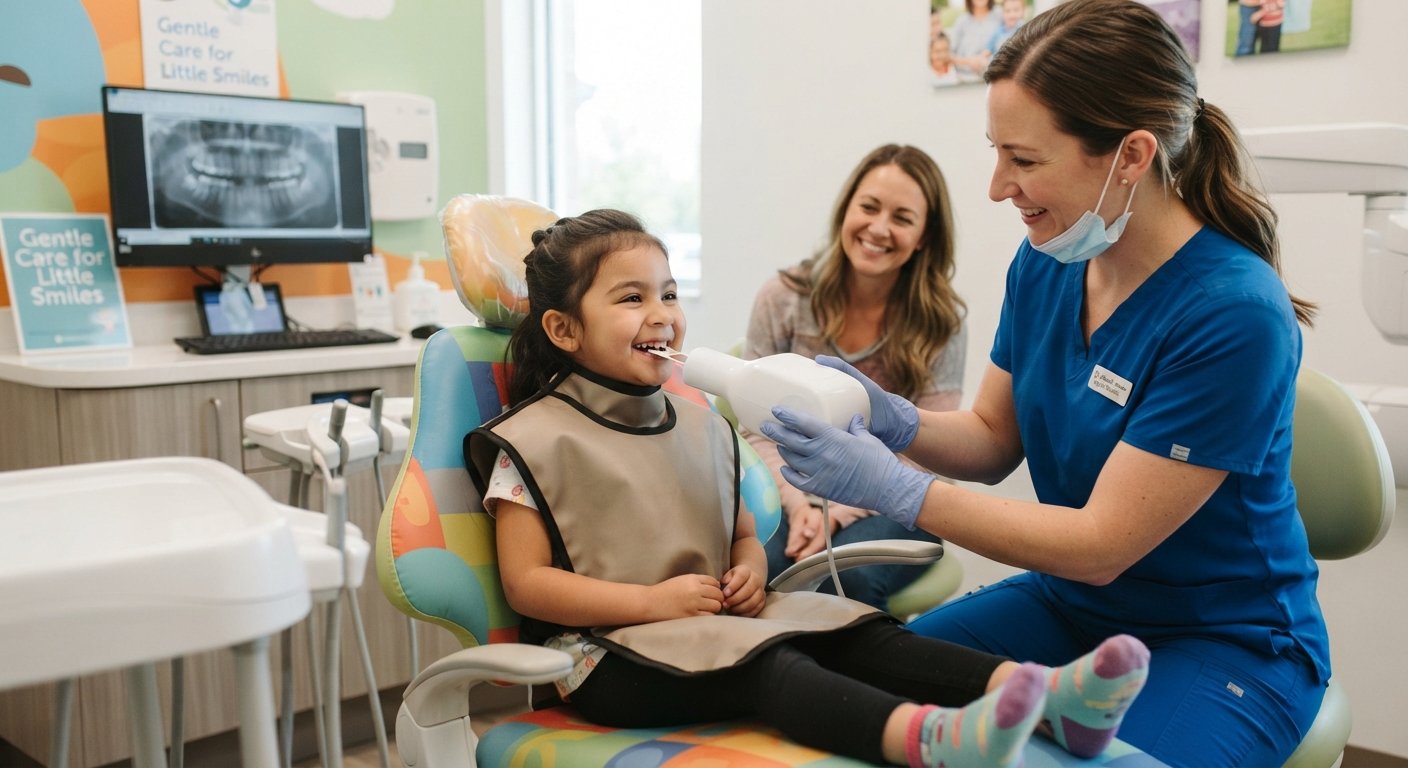
At almost every dental appointment for a child, a parent is asked to sign a consent form for dental X-rays for children — and many parents pause. Is this necessary? How often is too often? Is the radiation safe for a growing child? These are completely reasonable questions, and the fact that parents ask them reflects exactly the kind of engaged, protective instinct that good pediatric health care depends on. The answers are reassuring, evidence-based, and worth understanding clearly.
Dental X-rays for children are one of the most important diagnostic tools available in pediatric dentistry. They reveal decay between teeth that cannot be seen during a clinical examination, show the development of permanent teeth beneath the gums, identify bone abnormalities, and help providers detect problems at their earliest and most treatable stages. When used appropriately — at the right frequency, with modern equipment, and with proper protection — dental X-rays for children are both safe and indispensable. This guide explains everything parents need to know to make informed, confident decisions about dental X-rays for children at every stage of their child’s development.
Why Dental X-Rays for Children Are Clinically Essential
The most common objection parents raise to dental X-rays for children is the question of necessity: “Can’t the dentist just look?” The answer is that looking — even with the best lighting, magnification, and clinical skill — has fundamental physical limitations. A clinical examination can only assess what is visible on the outer surfaces of teeth and gums. The majority of tooth decay in children occurs in areas that are completely invisible to the naked eye: between the teeth, under the gumline, and beneath existing restorations. Without dental X-rays for children, these areas cannot be evaluated.
What Dental X-Rays for Children Can Detect That Visual Examination Cannot
- Interproximal decay: Cavities that form between teeth — the most common location for decay in school-age children — are completely invisible on visual examination until they are advanced. Dental X-rays for children detect these between-tooth cavities in their early stages when a simple filling is all that is needed.
- Decay under existing fillings: A tooth that has been previously restored can develop new decay beneath or around the filling. Dental X-rays for children are the only reliable way to detect secondary decay that is hidden under an apparently intact restoration.
- Permanent tooth development and eruption: Dental X-rays for children show the position, development status, and eruption path of every permanent tooth forming beneath the primary teeth. This information is essential for identifying impacted teeth, eruption problems, missing teeth, and abnormal development before they become clinical emergencies.
- Bone level and bone health: The level of bone surrounding the tooth roots is visible on dental X-rays for children, allowing early detection of bone loss from gum disease or infection before it produces visible symptoms.
- Abscesses and infections: A dental abscess at the root of a tooth produces a characteristic darkening of the surrounding bone on dental X-rays for children that may not produce visible swelling or pain in its early stages.
- Root length and bone support: Before extracting a primary tooth, placing a space maintainer, or beginning orthodontic treatment, dental X-rays for children provide essential information about root length, bone support, and the proximity of the developing permanent tooth.
Are Dental X-Rays for Children Safe? Understanding Radiation Exposure
Radiation exposure is the primary concern parents have about dental X-rays for children, and it deserves a thorough, honest response. The foundational principle is that all exposure to ionizing radiation carries some theoretical risk, and the goal of responsible dental X-ray use is to ensure that the diagnostic benefit always outweighs the theoretical risk — guided by the ALARA principle: As Low As Reasonably Achievable.
How Much Radiation Do Dental X-Rays for Children Involve?
The radiation dose from modern dental X-rays for children is extraordinarily small. A full set of four bitewing X-rays — the standard X-rays taken to check for interproximal decay — delivers a radiation dose of approximately 0.005 millisieverts (mSv). To put this in context, the average American receives approximately 3.1 mSv of background radiation annually just from naturally occurring sources in the environment (soil, building materials, cosmic rays, and radon gas). A single day of normal living exposes a person to more background radiation than a full set of dental X-rays for children delivers in the dental office.
Modern Digital Dental X-Rays for Children: Lower Dose, Higher Quality
The transition from traditional film-based X-rays to digital radiography has dramatically reduced the radiation exposure associated with dental X-rays for children. Digital sensors are significantly more sensitive than film, requiring less radiation to produce a diagnostic image. Modern digital dental X-rays for children deliver approximately 60 to 80 percent less radiation than their film-based predecessors, making an already minimal exposure even smaller. Digital technology also produces images that can be enhanced, magnified, and shared electronically — improving diagnostic quality while simultaneously reducing exposure.
Protective Measures During Dental X-Rays for Children
Several protective measures are used during dental X-rays for children to minimize exposure to areas of the body outside the dental region being imaged. A lead apron placed over the child’s torso shields the body. A thyroid collar — a small lead shield worn around the neck — protects the thyroid gland, which is particularly important in growing children whose thyroid cells are more active than in adults. Properly aimed X-ray beams, appropriate exposure settings for the child’s size, and limiting dental X-rays for children to clinically indicated situations all further minimize cumulative exposure.
How Often Should Children Receive Dental X-Rays?
The frequency of dental X-rays for children is not determined by a fixed schedule but by individual clinical assessment of the child’s risk factors and the findings of the current examination. The American Dental Association and the American Academy of Pediatric Dentistry have published evidence-based guidelines for dental X-rays for children that base frequency on the child’s decay risk level, the stage of dental development, and whether any active problems are being monitored.
Dental X-Rays for Children at Different Risk Levels
- High decay risk children: Bitewing X-rays every six months. Children with previous cavities, high sugar diets, inadequate oral hygiene, dry mouth, or other risk factors benefit from more frequent dental X-rays for children to catch new cavities early.
- Low decay risk children: Bitewing X-rays every twelve to twenty-four months. Children with excellent oral hygiene, low sugar diets, no history of cavities, and well-fluoridated water can safely extend the interval between dental X-rays for children.
- Panoramic X-rays: These comprehensive dental X-rays for children that image the entire jaw, all teeth, and surrounding structures are typically taken once in the early primary dentition, once in the mixed dentition around age six to eight, and once in the early permanent dentition around age twelve to thirteen to assess development, eruption, and any structural concerns.
These are guidelines, not rigid rules. A child who presents with new symptoms, dental trauma, swelling, or clinical findings that cannot be fully assessed without imaging may need dental X-rays for children outside the standard interval. Conversely, a child who has recently had dental X-rays for children with a previous provider does not need repeat imaging immediately — a good practice will request prior records rather than exposing the child unnecessarily.
Types of Dental X-Rays for Children and What Each Shows
Different types of dental X-rays for children serve different diagnostic purposes. Understanding which X-ray is being recommended and why helps parents engage meaningfully with treatment decisions.
Bitewing X-Rays
Bitewing dental X-rays for children show the crowns of the upper and lower back teeth on the same image, revealing interproximal (between-tooth) decay, the height of the bone between teeth, and secondary decay under existing restorations. They are the most commonly taken and most clinically important routine dental X-rays for children for decay detection and are the type whose frequency is most directly linked to individual decay risk.
Periapical X-Rays
Periapical dental X-rays for children show the entire tooth from crown to root tip, including the surrounding bone. They are taken when a provider needs to assess a specific tooth in detail — for example, to evaluate the root of a tooth with suspected infection, to assess the bone around an abscessed tooth, or to measure root length before a procedure. Periapical dental X-rays for children are targeted rather than routine and are taken in response to specific clinical findings.
Panoramic X-Rays
A panoramic X-ray is a single wide-field dental X-ray for children that captures the entire upper and lower jaw, all teeth present and developing, the jaw joints, and the surrounding bone in one image. It is the most comprehensive overview available in routine dental radiography and is invaluable for assessing overall dental development, identifying impacted or missing permanent teeth, evaluating the jaw joints, and planning orthodontic treatment. Because it provides a wide developmental overview rather than fine decay detail, panoramic dental X-rays for children complement but do not replace bitewing X-rays.
Cone Beam CT (CBCT)
Three-dimensional cone beam CT dental X-rays for children are used in specific clinical situations requiring three-dimensional imaging — most commonly for complex orthodontic planning, evaluation of impacted teeth, assessment of jaw abnormalities, or evaluation of airway dimensions. CBCT delivers more radiation than conventional dental X-rays for children and is therefore reserved for situations where the clinical question cannot be answered by two-dimensional imaging. When CBCT is recommended for a child, the provider should be able to explain specifically what clinical question it is being used to answer.
Helping Your Child Through Dental X-Rays: Practical Tips for Parents
For many children, the physical experience of dental X-rays — particularly the placement of sensors or film holders inside the mouth — is the most challenging part of the dental visit. The following strategies help children tolerate dental X-rays for children comfortably and cooperate with the procedure.
- Explain simply and honestly what will happen. Tell your child that the dentist is going to take pictures of their teeth with a special camera and that they will need to hold very still for a few seconds. Honest, simple preparation reduces the surprise that amplifies anxiety during dental X-rays for children.
- Mention the lead apron positively. Some children find wearing the lead apron during dental X-rays for children exciting — frame it as a special superhero shield or space suit rather than a protective measure against something scary.
- Practice at home. Place a small object gently on your child’s tongue at home and ask them to hold still for five seconds. This simple exercise reduces the gag and startle response that makes sensor placement during dental X-rays for children challenging for some children.
- Let the provider use child-adapted sensor holders and digital systems. Modern pediatric dental offices use sensors and holders specifically sized for children’s smaller mouths, making dental X-rays for children more comfortable than adult-adapted equipment would be.
- Stay calm yourself. If you are visibly anxious about dental X-rays for children, your child will mirror that anxiety. Providers who specialize in pediatric care are experienced at managing the practical challenges of taking dental X-rays for children and will guide the process confidently.
At Fayrouz Pediatrics, we use modern digital radiography for all dental X-rays for children, ensuring the lowest possible radiation exposure while delivering the highest diagnostic quality. We take dental X-rays for children only when clinically indicated, explain every recommendation clearly to families, and welcome questions about why specific dental X-rays for children are being recommended at any visit. Learn more at our pediatric dentist treatment page.
Frequently Asked Questions About Dental X-Rays for Children
Can I refuse dental X-rays for my child?
Yes. Parents always have the right to decline dental X-rays for children, and a good provider will respect that decision while clearly explaining the clinical implications. The important thing to understand is that declining dental X-rays for children does not eliminate the risks that the X-rays would have detected — it simply means those risks will not be identified until they produce visible symptoms, at which point the condition is typically more advanced and requires more complex treatment. If you have specific concerns about dental X-rays for children, discuss them openly with your provider. They can explain exactly which dental X-rays for children are being recommended and why, and help you make a genuinely informed decision.
At what age can children start having dental X-rays?
There is no minimum age for dental X-rays for children when they are clinically indicated. Dental X-rays for children can be taken as soon as a child has teeth that are in contact with adjacent teeth — typically around age two to three for the primary molars — because this is when interproximal decay between those teeth becomes possible and undetectable without imaging. In practice, dental X-rays for children are taken based on clinical need and the child’s ability to cooperate with the procedure, not based on a fixed age threshold. For most children, the first routine bitewing dental X-rays for children are taken sometime between ages three and five.
Do dental X-rays for children need to be repeated if we switch dentists?
Not necessarily. When a family changes dental providers, the new practice should request the child’s previous dental X-rays for children from the prior office before taking new ones. If the previous dental X-rays for children are recent, of adequate diagnostic quality, and cover the clinical areas of interest, they can be used in lieu of new exposure. Dental X-rays for children should not be repeated solely for administrative reasons when a family switches providers — the clinical need for current diagnostic images should always drive the decision. Parents who are switching providers should proactively request a copy of their child’s previous dental X-rays for children to bring to the new office.
Are dental X-rays for children safe during pregnancy — for the parent accompanying the child?
Yes. Dental X-rays for children are taken with a highly focused, directed beam that is aimed at the child’s mouth. The scatter radiation outside the primary beam is extremely low. A pregnant parent accompanying a child during dental X-rays for children and sitting outside the primary beam area is exposed to negligible scatter radiation — far less than the background radiation they encounter during a typical day. If a pregnant parent is concerned, they may step outside the room for the few seconds during which dental X-rays for children are taken, which is a perfectly reasonable and easy accommodation that any dental office will provide.
Dental X-rays for children are not something to fear — they are something to understand. Used at the right frequency, with modern digital technology, appropriate protection, and clear clinical indication, dental X-rays for children are among the safest and most valuable diagnostic tools in pediatric health care. They allow providers to see what examination alone cannot reveal, catch problems at their most treatable stages, and monitor your child’s dental development with a level of precision that protects their oral health for a lifetime. When your child’s provider recommends dental X-rays for children, you now have everything you need to ask the right questions and say yes with confidence.
