


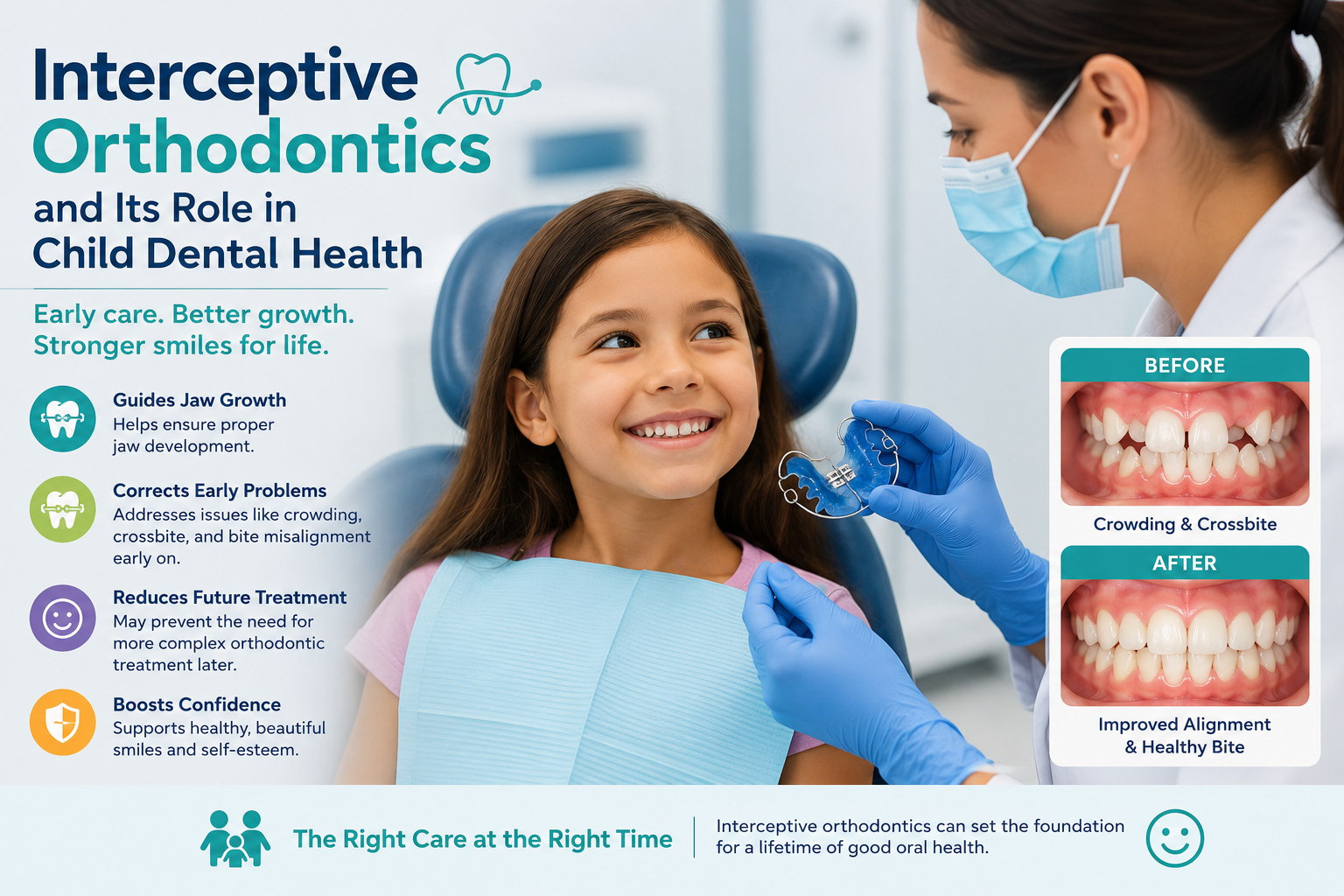
Most parents think of braces as something that happens in middle school — a rite of passage for the early teen years once all the permanent teeth have come in. But there is a growing body of evidence, and a well-established branch of pediatric dental practice, built on a different premise entirely: that the best time to address many bite and alignment problems is before they fully develop, not after. That premise is the foundation of interceptive orthodontics.
Interceptive orthodontics is not a fringe approach. It is a recognized phase of orthodontic care that has been practiced for decades and is recommended by the American Association of Orthodontists for children as young as age seven. Yet many families — including multilingual and multicultural families, families of school-age children, and parents navigating the American healthcare system for the first time — have never heard of it, or do not fully understand what it involves or why it matters.
This guide explains what interceptive orthodontics is, who it is for, how technology is shaping its practice, and why the timing of intervention — including seasonal planning — can have a meaningful impact on treatment outcomes and family logistics. If your child is between the ages of six and twelve, this is information worth having.
What Is Interceptive Orthodontics?
Interceptive orthodontics, also called Phase One orthodontics or early orthodontic treatment, refers to orthodontic intervention that takes place while a child still has a mix of primary (baby) and permanent teeth — typically between the ages of six and ten. The word “interceptive” is deliberately chosen: the goal is to intercept developing dental and skeletal problems before they become fixed, reducing their severity or eliminating the need for more extensive treatment later.
This stands in contrast to comprehensive orthodontics — the braces or aligners that most people are familiar with — which typically begins after all permanent teeth have erupted, usually around age twelve or thirteen. Comprehensive treatment corrects problems that are already fully formed. Interceptive orthodontics works with the natural growth processes of the jaw and facial skeleton to guide development in a healthier direction while those structures are still actively forming and responsive to gentle forces.
What Problems Can Interceptive Orthodontics Address?
Interceptive orthodontics is most effective for problems that are skeletal in origin — meaning they involve the size, shape, or relationship of the jaw bones themselves rather than just the position of individual teeth. These include:
- Crossbites: When the upper jaw is narrower than the lower, causing upper teeth to sit inside the lower teeth when biting. A palatal expander used in interceptive orthodontics can widen the upper arch over several months, correcting the crossbite before it causes facial asymmetry or jaw joint problems.
- Underbites: When the lower jaw protrudes beyond the upper, causing the lower front teeth to sit in front of the upper front teeth. Early intervention with a reverse-pull headgear or functional appliance can redirect jaw growth with far greater success than treatment attempted after growth has completed.
- Severe crowding: When the jaw is too small to accommodate the erupting permanent teeth, interceptive orthodontics can create space through expansion or strategic removal of specific primary teeth, reducing the likelihood of extraction of permanent teeth later.
- Excessive overjet or deep bite: Significant protrusion of the upper front teeth or excessive overlap of the upper teeth over the lower responds well to interceptive appliances that redirect jaw growth while the facial skeleton is still pliable.
- Harmful oral habits: Persistent thumb sucking or tongue thrusting that has already begun affecting jaw development can be managed as part of an interceptive orthodontics plan, using appliances that discourage the habit while simultaneously guiding the jaw back toward a healthier position.
What Interceptive Orthodontics Is Not
It is equally important to understand the boundaries of interceptive orthodontics. It is not a replacement for comprehensive treatment — most children who undergo Phase One will still require Phase Two (comprehensive braces or aligners) once all permanent teeth have erupted. The goals of interceptive orthodontics are to reduce the complexity and duration of that later treatment, eliminate conditions that would require more invasive correction if left until adolescence, and create better outcomes for jaw function, facial balance, and long-term oral health. Not every child needs it. A qualified pediatric provider will evaluate each child individually to determine whether early intervention is genuinely indicated or whether a watch-and-wait approach is more appropriate.
Indicators Your Child May Benefit from Early Assistance
Parents are often the first to notice that something seems off about the way their child’s teeth fit together or how their jaw moves. These observations are worth taking seriously. While a professional evaluation is always necessary to determine whether interceptive orthodontics is appropriate, there are several signs that warrant a conversation with your child’s pediatric provider sooner rather than later.
Physical Signs to Watch For
- Early or late loss of baby teeth: Baby teeth that are lost significantly earlier or later than the typical timeline can disrupt the eruption sequence of permanent teeth, leading to crowding or misalignment that interceptive orthodontics may be able to address.
- Difficulty biting or chewing: If your child consistently avoids certain foods, chews on one side only, or complains that eating is uncomfortable, this may reflect a bite problem that interceptive orthodontics could correct.
- Mouth breathing and snoring: Chronic mouth breathing in children is often associated with a narrow upper arch or adenoid and tonsil concerns. A narrow palate that contributes to mouth breathing can be widened through palatal expansion, one of the most commonly used interceptive orthodontics appliances.
- Visible jaw shifting when biting: If your child’s jaw visibly shifts to one side when they close their teeth together, this is a classic sign of a functional crossbite that benefits strongly from early interceptive orthodontics intervention.
- Crowded, overlapping, or widely spaced front teeth: Noticeable crowding or spacing in the front teeth when permanent incisors first erupt (around ages six to eight) can indicate jaw size discrepancies that interceptive orthodontics is designed to address.
- Speech difficulties: Lisps, difficulty pronouncing specific sounds, or persistent articulation challenges may be partially rooted in jaw or bite problems that interceptive orthodontics can help resolve.
- Thumb sucking or pacifier use beyond age four: Habits that have persisted past the window when self-correction is likely may have already begun affecting jaw development. A provider trained in interceptive orthodontics can assess the extent of any structural changes and recommend appropriate intervention.
When to Seek an Evaluation
The American Association of Orthodontists recommends that children receive their first orthodontic evaluation by age seven, even if no problems are visible to the parent. By age seven, enough permanent teeth have erupted to allow a trained provider to assess jaw development, eruption patterns, and bite relationships with accuracy. For most children, the evaluation will confirm that no early treatment is needed — but it establishes a baseline and a monitoring relationship that means any developing problems will be caught at the optimal time for interceptive orthodontics to be most effective.
How Technology Supports Early Treatment in Healthcare
The practice of interceptive orthodontics has been transformed over the past two decades by advances in diagnostic imaging, digital treatment planning, and appliance fabrication technology. These innovations have made early evaluation more precise, treatment planning more individualized, and appliance delivery more comfortable and efficient — all of which benefits families seeking interceptive orthodontics for their children.
3D Cone Beam Computed Tomography (CBCT)
Traditional two-dimensional X-rays provide useful information but have significant limitations when evaluating jaw relationships, unerupted tooth positions, and airway dimensions — all of which are relevant to interceptive orthodontics planning. Cone beam CT imaging produces a three-dimensional model of the child’s skull, jaw, teeth, and airway in a single low-radiation scan that takes less than a minute. This allows providers to identify impacted teeth, assess jaw symmetry, and evaluate airway dimensions with a level of accuracy that was simply not available a generation ago.
Digital Intraoral Scanning
The traditional process of taking dental impressions using putty-filled trays was uncomfortable for children and particularly challenging for those with a strong gag reflex. Digital intraoral scanners now create highly accurate three-dimensional models of the teeth and bite without any physical impression material. The scan takes minutes, produces immediate visual feedback on a screen that children often find engaging, and generates models that can be shared electronically with specialists involved in an interceptive orthodontics case.
Digital Treatment Simulation and Growth Prediction
Software platforms now allow providers to simulate the projected growth of a child’s jaw, model the expected movement of unerupted teeth, and demonstrate to families the before-and-after trajectory of interceptive orthodontics treatment in visual terms. This technology serves both a clinical function — improving treatment planning accuracy — and a communication function, helping parents from all backgrounds and with varying levels of dental knowledge understand clearly what the proposed treatment is intended to achieve and why the timing matters.
CAD/CAM Appliance Fabrication
The appliances used in interceptive orthodontics — palatal expanders, space maintainers, habit appliances, and functional devices — can now be designed and fabricated digitally using computer-aided design and computer-aided manufacturing (CAD/CAM) technology. Digital fabrication produces appliances that fit more precisely, require fewer adjustment visits, and can be delivered faster than those made through traditional laboratory processes. For families with busy schedules, including families managing multiple children’s healthcare appointments, fewer clinic visits is a meaningful quality-of-life advantage.
Why Spring Timing Helps Improve Planning and Decisions
For families considering interceptive orthodontics, the question of when to schedule an evaluation and when to begin treatment is more nuanced than it might appear. The clinical window for effective early intervention is determined by a child’s individual developmental stage, not by the calendar. But within that clinical window, the time of year a family chooses to begin treatment can meaningfully affect how smoothly the process unfolds — and spring, in particular, offers several practical advantages.
Better Scheduling Flexibility Before Summer
Beginning interceptive orthodontics in the spring means that the initial adjustment period — when children are getting used to a new appliance and may need additional appointments for adjustments, tightening, or minor issues — falls during a season when families typically have more scheduling flexibility than during the back-to-school rush of late summer or the holiday disruptions of fall and winter. Spring appointments are also generally easier to schedule because demand for pediatric healthcare services is lower in March through May than in the peak seasons of August and December.
Summer as a Natural Adjustment Window
Children who begin interceptive orthodontics in the spring benefit from the summer break as an extended adjustment window. Speech changes that accompany palatal expanders and other appliances, dietary adjustments required for appliance care, and the mild discomfort that follows activation appointments are all easier to manage when a child is not simultaneously navigating a full school day. By the time school resumes in the fall, most children have fully adapted to their appliance and the treatment is progressing smoothly.
Annual Benefit Resets and Insurance Planning
For families with dental insurance that includes an orthodontic benefit, initiating interceptive orthodontics in the spring allows time to understand benefit structures, submit pre-authorization requests, and plan for any out-of-pocket costs before the new benefit year resets in January. Starting the conversation in spring rather than waiting until the fall gives families more time to make informed financial decisions without the pressure of an imminent school-year start or holiday season.
Emotional Readiness and Parental Engagement
Spring evaluations also benefit from the natural reflection that accompanies the end of a school year. Parents who attend a spring evaluation can absorb the provider’s recommendations over the summer months, ask follow-up questions, research the proposed interceptive orthodontics appliance at their own pace, and involve their child in the decision-making process with enough time to build genuine understanding and buy-in before treatment begins. This is particularly valuable for multilingual families where healthcare communication may involve translation or additional clarification, and for parents of children who experience anxiety around new medical procedures.
The Connection Between Interceptive Care and Long Term Oral Health
The case for interceptive orthodontics is not made solely on the grounds of aesthetics or the desire for a straight smile. The structural and functional benefits of early intervention have measurable, long-term effects on oral health that extend well beyond how teeth look in a photograph.
Improved Oral Hygiene Across a Lifetime
Crowded and overlapping teeth are significantly harder to clean effectively than well-aligned teeth. Plaque accumulates in areas a toothbrush cannot reach, and flossing becomes difficult or impossible in tightly crowded regions. Children and adults with crowded teeth have measurably higher rates of decay and gum disease because their oral hygiene routine, however diligent, cannot adequately address all tooth surfaces. By creating space and aligning teeth during the developmental window when interceptive orthodontics is most effective, providers reduce a child’s lifetime risk of dental disease.
Reduced Risk of Tooth Injury
Protruding upper front teeth — one of the most common conditions addressed by interceptive orthodontics — are significantly more vulnerable to traumatic injury than teeth in a normal position. Studies consistently show that children with untreated excessive overjet are two to three times more likely to suffer trauma to their upper front teeth from falls, sports impacts, and everyday childhood accidents. Retracting these teeth through early intervention directly reduces this injury risk during the most active years of childhood.
Better Jaw Function and Airway Health
A narrow upper arch does not just cause dental crowding — it also reduces the volume of the nasal airway, because the roof of the mouth is the floor of the nose. Children with narrow palates often breathe through their mouths, sleep poorly, and in some cases develop sleep-disordered breathing patterns. Palatal expansion as part of an interceptive orthodontics plan widens the arch, creates room for the teeth, and simultaneously improves nasal airway dimensions. For some children, this single intervention produces dramatic improvements in sleep quality, daytime energy, and concentration.
Reduced Complexity and Duration of Later Treatment
Children who receive well-timed interceptive orthodontics typically have significantly shorter and less complex comprehensive orthodontic treatment in adolescence. Skeletal problems that were corrected during the growth phase no longer need to be compensated for with tooth movements alone. Space that was created early means that permanent teeth erupt into better positions, reducing the total work required. In some cases, interceptive orthodontics eliminates the need for tooth extractions that would otherwise have been necessary to create adequate space — a meaningful benefit for children and their families.
At Fayrouz Pediatrics, we believe that proactive, evidence-based care during childhood builds the foundation for a lifetime of oral health. Our team works with families at every stage — from infants to teens — to identify developing concerns early and connect families with the right resources and referrals at the right time. Whether your child needs a routine evaluation or a more detailed assessment of jaw development, we are here to guide you through every step. Explore the full range of our services, including pediatric dentist treatment options, to learn more about how we support your child’s dental health.
Frequently Asked Questions About Interceptive Orthodontics
At what age should a child first see an orthodontist?
The American Association of Orthodontists recommends that every child receive a first orthodontic evaluation by age seven. This does not mean that treatment will begin at seven — for the majority of children, the evaluation will confirm that no early intervention is needed at that time. However, age seven represents the optimal window for an initial screening because enough permanent teeth have erupted to allow an accurate assessment of jaw development, bite relationships, and tooth eruption patterns. If a child shows signs of a developing problem such as a crossbite, severe crowding, or significant overjet, interceptive orthodontics may be recommended to begin during this window. If no concerns are identified, the provider will typically monitor the child at regular intervals until comprehensive treatment becomes appropriate.
How long does interceptive orthodontics treatment typically take?
The duration of interceptive orthodontics treatment varies depending on the specific problem being addressed and the appliance used. Palatal expansion for a crossbite typically involves active expansion over a period of three to six months, followed by a retention phase of six to twelve months to allow the new bone to consolidate. Space maintenance appliances may be worn for one to three years depending on the eruption timeline of the permanent teeth. Functional appliances used to redirect jaw growth are typically worn for twelve to eighteen months. In all cases, the Phase One interceptive orthodontics phase is followed by a resting period, after which the provider will assess whether and when Phase Two comprehensive treatment should begin. The total timeline from first evaluation to completion of Phase Two typically spans several years, but the treatment complexity and duration of Phase Two is generally reduced by successful interceptive orthodontics.
Does interceptive orthodontics hurt?
Most children tolerate interceptive orthodontics appliances very well, though some degree of initial discomfort is normal as the mouth adapts to a new appliance. Palatal expanders, which exert gentle pressure on the suture at the center of the upper jaw, may cause mild soreness or pressure for one to three days after each activation. Children often report a feeling of tightness or fullness in the palate rather than sharp pain. Over-the-counter children’s pain relief medication, soft foods for a day or two after adjustments, and rinsing with warm salt water typically manage any discomfort well. Speech changes — a temporary lisp or altered “s” sounds — are also common in the first few weeks with an expander or other palatal appliance, but most children adapt completely within two to four weeks. If a child experiences significant or persistent pain with an interceptive orthodontics appliance, the family should contact the provider, as this may indicate a fit issue that needs to be addressed.
Will my child still need braces after interceptive orthodontics?
In most cases, yes — children who complete Phase One interceptive orthodontics will still benefit from Phase Two comprehensive treatment once all permanent teeth have erupted. It is important for families to understand this upfront so that early treatment is seen as the first part of a two-phase process rather than a complete solution. What interceptive orthodontics changes is the nature and duration of that second phase. Children who had a crossbite corrected, a palate expanded, or significant overjet reduced through early intervention typically need less time in comprehensive braces, may avoid the need for tooth extractions, and experience better overall outcomes than children who received no early treatment. In a smaller number of cases — particularly those involving minor crossbites or simple space maintenance — Phase One may address the problem so completely that Phase Two is either unnecessary or minimal. Your child’s provider will be able to give a realistic expectation for both phases at the time of the initial interceptive orthodontics evaluation.
Interceptive orthodontics is one of the most powerful tools available in pediatric dental care precisely because it works with biology rather than against it. The jaw and facial skeleton of a growing child are remarkably responsive to gentle, well-directed forces — forces that become far less effective once growth has slowed and the bones have hardened. Identifying the right problems at the right developmental stage, and addressing them with the precision that modern technology enables, is how interceptive orthodontics delivers outcomes that simply cannot be replicated by waiting. For every family reading this, the most important first step is the same: an evaluation. The sooner a trained provider has a clear picture of your child’s dental development, the more options remain available to you.
