


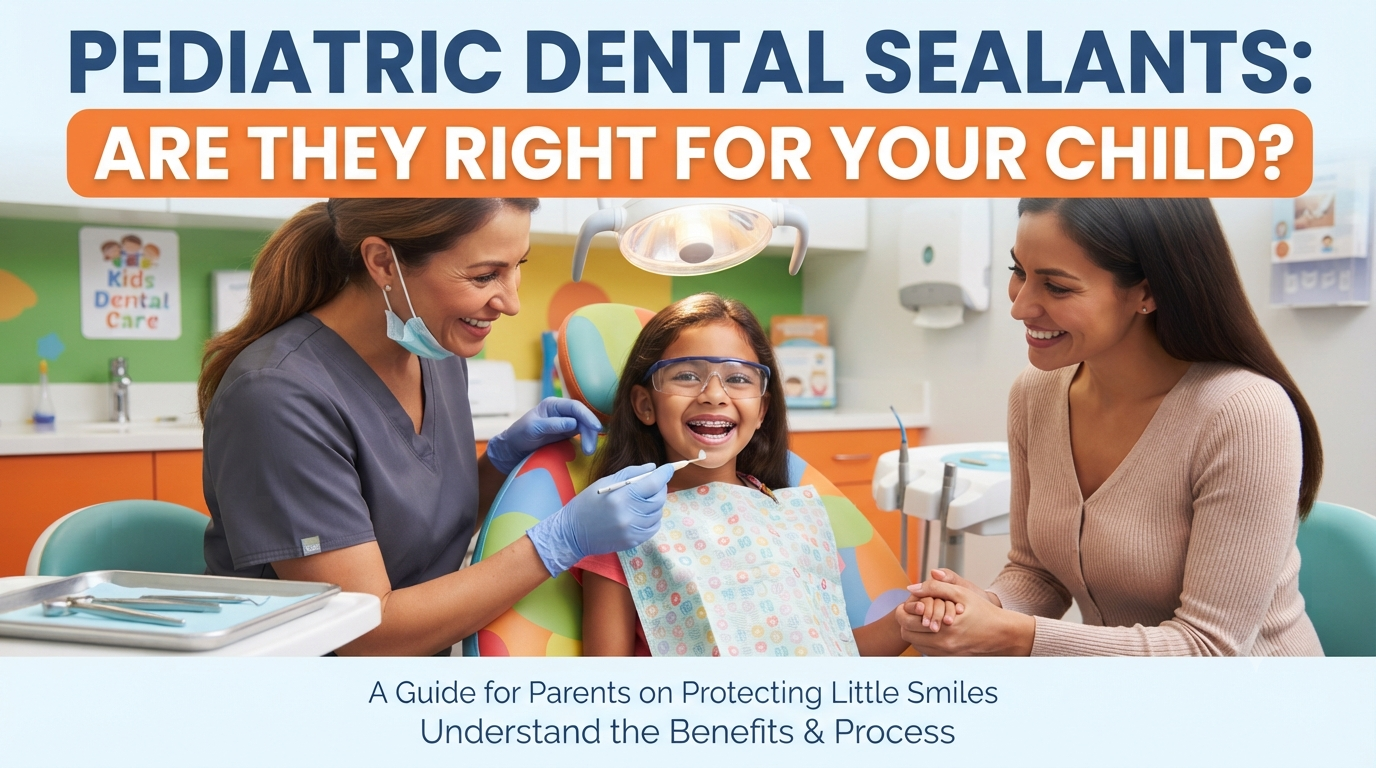
Even children who brush twice daily, floss regularly, and eat a low-sugar diet have one vulnerability their oral hygiene routine cannot fully address: the deep pits and fissures on the chewing surfaces of their molars. These grooves are so narrow that the bristles of a standard toothbrush cannot reach their deepest points, creating pockets where food debris and bacteria accumulate regardless of how carefully a child brushes. Pediatric dental sealants are the clinical solution to this specific structural vulnerability — a thin protective coating applied to the chewing surfaces of molars that physically seals out the bacteria and acids that cause the majority of childhood cavities in these teeth.
This guide gives parents a complete, clear picture of what pediatric dental sealants are, how they work, when they are recommended, what the application process involves, and how long they last. Whether you are a parent of a school-age child whose first permanent molars have recently erupted or a parent trying to decide whether pediatric dental sealants are worth it for your teen’s second molars, the information here will help you make an informed, confident decision.
What Are Pediatric Dental Sealants and How Do They Work?
Pediatric dental sealants are thin plastic or resin coatings that are applied to the chewing surfaces of the back teeth — primarily the first and second permanent molars — to protect them from decay. The sealant material flows into the deep grooves and pits of the molar surface and is hardened with a curing light, creating a smooth, sealed surface that bacteria and food particles cannot penetrate.
The protective mechanism of pediatric dental sealants is straightforward: by filling in the deep anatomical features of molar surfaces where brushing cannot reach, they eliminate the microenvironments where the bacteria responsible for pit-and-fissure decay colonize, feed, and produce the acid that dissolves enamel. Studies consistently show that children with pediatric dental sealants on their first permanent molars have significantly lower rates of decay on those teeth than children without sealants, with some research demonstrating an 80 percent reduction in cavities in the first two years after application.
Who Should Get Pediatric Dental Sealants and When?
Pediatric dental sealants are recommended by the American Dental Association and the American Academy of Pediatric Dentistry for children and adolescents as soon as susceptible tooth surfaces are fully erupted and can be isolated and dried for the application procedure.
First Permanent Molars: Ages 6–7
The first permanent molars erupt behind the primary teeth around age six to seven and are the highest-priority teeth for pediatric dental sealants. They will be in the mouth for a lifetime, they erupt before a child has the dexterity to brush them effectively, and their anatomy is typically characterized by deep, narrow fissures that are particularly susceptible to pit-and-fissure decay. Placing pediatric dental sealants on first permanent molars as soon as they are fully erupted and can be properly isolated is one of the highest-yield preventive investments available in pediatric dentistry.
Second Permanent Molars: Ages 11–13
The second permanent molars erupt in early adolescence and represent a second priority window for pediatric dental sealants. Teenagers face elevated decay risk due to dietary choices, irregular oral hygiene habits, and the introduction of orthodontic appliances that make cleaning more complex. Sealing the second molars at the time of eruption provides protection during these higher-risk adolescent years.
Primary Molars for High-Risk Children
For children at elevated decay risk — those with previous cavities, diets high in refined carbohydrates, limited access to preventive care, or special healthcare needs — pediatric dental sealants on primary molars can also be considered. While primary molars will eventually be shed, they serve critical functions for chewing and space maintenance for years before that happens, and protecting them from decay in high-risk children is a legitimate and evidence-supported indication for sealant application.
The Pediatric Dental Sealants Application Process: What to Expect
One of the most reassuring things about pediatric dental sealants for parents and children alike is that the application process is quick, painless, and requires no drilling or anesthesia. Understanding what happens during the procedure removes the anxiety of the unknown.
- Cleaning: The tooth surface is thoroughly cleaned and polished to remove any plaque, bacteria, or food debris from the pits and fissures before the sealant is placed.
- Isolation and drying: The tooth is isolated with cotton rolls or a rubber dam and thoroughly dried. This step is critical — pediatric dental sealants bond to dry enamel, and any moisture contamination will compromise the seal and long-term retention.
- Etching: A mild acidic gel is applied to the tooth surface for a few seconds to slightly roughen the enamel and create a better bonding surface for the sealant material.
- Sealant application: The liquid sealant material is carefully flowed into the grooves and pits of the molar surface, ensuring complete coverage of the susceptible areas.
- Curing: A blue curing light is used to harden the sealant material in about thirty seconds. Once cured, the pediatric dental sealants are immediately ready for normal chewing function.
- Check and polish: The bite is checked and any high spots are polished to ensure the sealant does not interfere with normal occlusion.
The entire pediatric dental sealants procedure for four teeth typically takes twenty to thirty minutes and is well tolerated by children who are cooperative for dental treatment. No needles, no drills, no pain — simply a procedure that quietly, invisibly protects teeth against the most common type of childhood cavity.
How Long Do Pediatric Dental Sealants Last?
Pediatric dental sealants can last anywhere from five to ten years when they are applied correctly, to teeth that are adequately dry during placement, using quality materials. With proper placement and appropriate monitoring, some sealants remain intact and protective for longer. However, pediatric dental sealants can chip, wear, or partially detach over time, particularly if a child grinds their teeth or consistently chews on hard objects. This is why sealant integrity is checked at every regular dental appointment — a sealant that has partially chipped away is no longer providing complete protection and may need to be reapplied to maintain its preventive benefit.
Addressing Common Concerns About Pediatric Dental Sealants
Some parents have questions or concerns about pediatric dental sealants that deserve direct, evidence-based answers.
BPA in Pediatric Dental Sealants
Some resin-based pediatric dental sealants contain trace amounts of bisphenol A (BPA) precursors that can be released in very small quantities immediately after application. The American Dental Association and the American Academy of Pediatric Dentistry have reviewed the available evidence and concluded that the amount of BPA exposure from pediatric dental sealants is extremely small — far below levels associated with health effects — and that the protective benefits of sealants substantially outweigh any theoretical risk. BPA-free sealant materials are also available and can be requested by families with specific concerns.
Can Decay Develop Under Pediatric Dental Sealants?
Decay can develop under pediatric dental sealants if they are placed over a tooth that already has very early decay in the grooves, or if the sealant partially detaches and the margins are no longer sealed. Research has actually shown that when intact sealants are placed over early, non-cavitated decay, the decay does not progress because the bacteria beneath the sealant are deprived of their sugar supply and become inactive. This finding has led to broader acceptance of sealant placement over very early lesions in certain clinical situations. However, the standard approach remains placing pediatric dental sealants on sound, decay-free tooth surfaces whenever possible.
Our providers at Fayrouz Pediatrics assess every child for pediatric dental sealants eligibility at regular preventive visits and provide sealant application as part of our comprehensive preventive services. To learn more, visit our pediatric dentist treatment page.
Frequently Asked Questions About Pediatric Dental Sealants
Do pediatric dental sealants hurt to apply?
No. The pediatric dental sealants application procedure is completely painless and requires no anesthesia. The teeth are cleaned, dried, and coated — there is no drilling, no injections, and no removal of any tooth structure. Children typically find the procedure easier to tolerate than a standard cleaning appointment because there is no scraping or probing. The main challenge for younger children is keeping the teeth dry during the isolation step, which requires staying still and open for a few minutes — a manageable task for most school-age children.
Are pediatric dental sealants covered by insurance?
Most dental insurance plans in the United States cover pediatric dental sealants for children up to age eighteen on permanent molars, often at 100 percent with no copay when placed within a specified time after molar eruption. Coverage details vary by plan, and some plans have age restrictions or limit coverage to specific teeth. It is always worth contacting your insurance provider or the dental office billing team before the appointment to confirm coverage. For families without insurance, the cost of pediatric dental sealants is typically modest relative to the cost of treating the decay they prevent, and many pediatric dental offices offer payment plans or sliding-scale fees.
Can pediatric dental sealants be placed if my child already has braces?
Pediatric dental sealants can generally be placed on molar surfaces that are not covered by orthodontic brackets, and doing so is actually strongly recommended because children in orthodontic treatment face elevated decay risk from the difficulty of cleaning around brackets and wires. However, isolation during the sealant application is more challenging with orthodontic hardware present, and the sealant must not interfere with bracket placement or bite alignment. Your dental provider and orthodontist can coordinate the most appropriate timing and approach for pediatric dental sealants during orthodontic treatment for your child specifically.
If my child gets pediatric dental sealants, do they still need to brush and floss?
Absolutely yes. Pediatric dental sealants protect the chewing surfaces of the back teeth — the pits and fissures where the majority of molar cavities originate — but they do not cover the smooth sides of the teeth or the surfaces between teeth. Decay on smooth surfaces and between teeth is still entirely possible in children with sealants, and flossing remains essential for cleaning the contact areas that no sealant covers. Pediatric dental sealants are one layer of a multi-layered preventive approach; they do not replace brushing, flossing, diet management, fluoride, or regular professional care.
Pediatric dental sealants represent some of the best evidence-supported value in preventive dentistry. A quick, painless, affordable procedure that can prevent years of cavity treatment in the most cavity-prone areas of the mouth — for children who are already doing everything else right, sealants may be the piece that completes the picture. For children who face a higher-risk oral environment, they can be genuinely transformative. Ask your child’s provider at the next visit whether the timing is right.
Clinically reviewed by the pediatric care team at Fayrouz Pediatrics — providing evidence-based pediatric dental sealants and comprehensive preventive dental care for children across the United States.
