


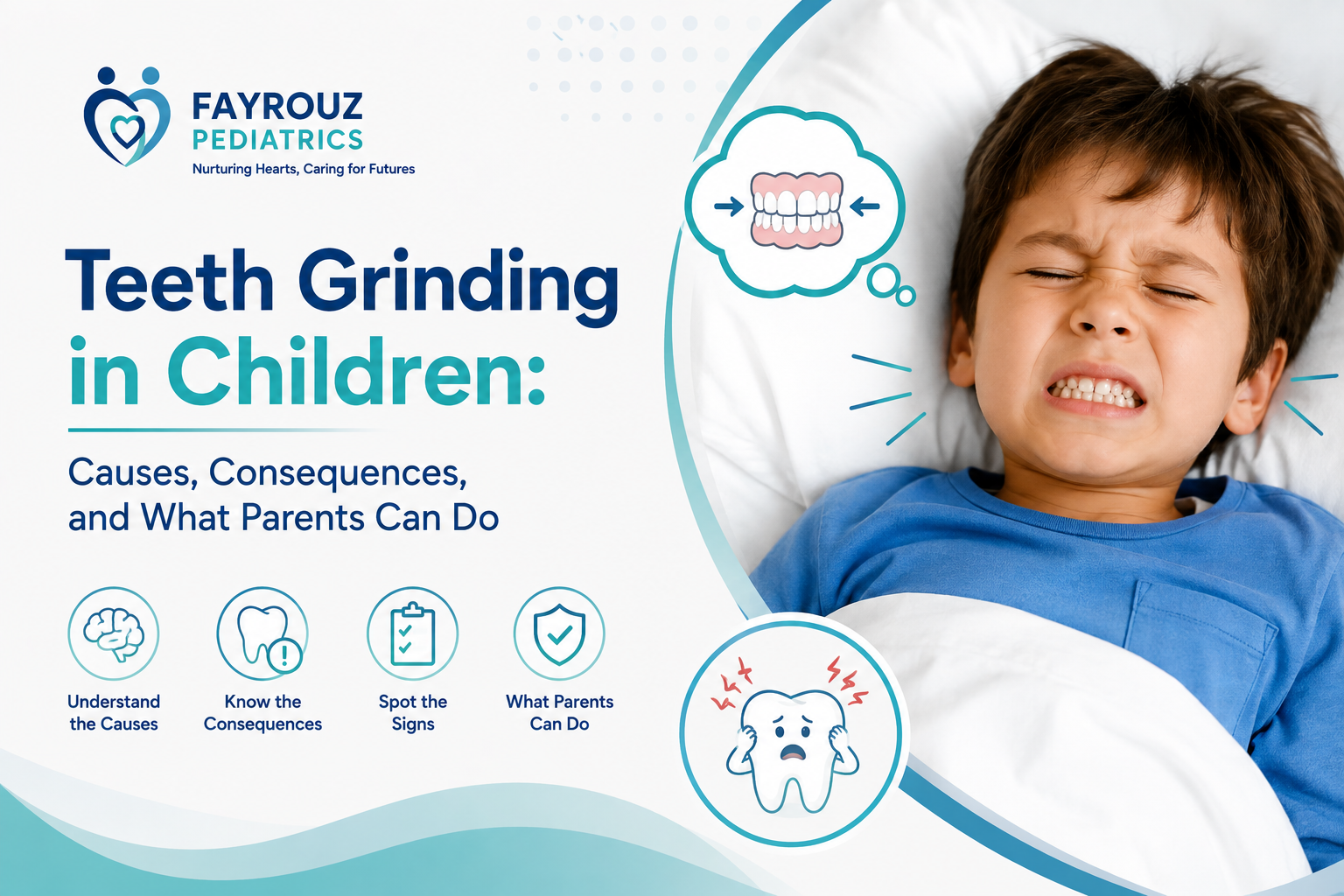
You put your child to bed, tiptoe away, and then hear it — a rhythmic, grating sound coming from your child’s room that stops you in the hallway. Teeth grinding in children is one of the most alarming sounds a parent can hear at night, and it is also one of the most commonly misunderstood. Is it harmful? Will it damage the teeth permanently? Does it mean something is wrong? Should you wake the child? These are the questions that send parents searching for answers in the middle of the night, and they deserve clear, evidence-based responses.
Teeth grinding in children — clinically known as bruxism — is far more prevalent than most parents realize. Studies estimate that between fourteen and twenty percent of children grind their teeth at some point during childhood, making it one of the most common pediatric oral health findings a provider encounters. This guide covers everything parents need to understand about teeth grinding in children: what causes it, when it becomes a clinical concern, what the consequences are for the teeth and jaw, and what steps parents and providers can take to protect a grinding child’s smile.
What Is Teeth Grinding in Children?
Teeth grinding in children refers to the involuntary clenching, gnashing, or grinding of the upper and lower teeth against each other. It most commonly occurs during sleep, making it a form of sleep bruxism, though some children also grind during waking hours when concentrating, stressed, or anxious. The grinding action generates forces that can be significantly higher than those produced during normal chewing, sometimes reaching several hundred pounds of pressure per square inch — a level that, sustained over months and years, causes measurable wear to tooth enamel, strain on the jaw joints, and muscle fatigue.
Teeth grinding in children is most commonly observed in two distinct age peaks: in young children between the ages of three and six, when the primary dentition is fully established, and again in early adolescence during the transition to the permanent dentition. In many cases, teeth grinding in children resolves on its own as the child grows and the dental and skeletal systems mature. In other cases, it persists into adulthood or causes enough damage during childhood to require professional intervention.
Sleep Bruxism vs. Awake Bruxism in Children
The majority of teeth grinding in children occurs during sleep, particularly during the lighter sleep stages and during transitions between sleep cycles. Because it happens unconsciously, parents are often more aware of it than the child. Awake bruxism — grinding or clenching during the day — is less common in children but is more directly associated with psychological stress and anxiety. Both forms of teeth grinding in children can cause similar patterns of tooth wear and jaw muscle strain, though sleep bruxism tends to be more intense because the body’s normal protective reflexes are diminished during sleep.
What Causes Teeth Grinding in Children?
The exact cause of teeth grinding in children is not fully understood and is likely multifactorial — meaning several contributing factors interact to produce the behavior in any given child. Research has identified the following as the most significant and consistent contributors.
Stress and Anxiety
Psychological stress is one of the most consistently identified triggers for teeth grinding in children. School pressures, social difficulties, family conflict, major life transitions such as moving or a new sibling, and general anxiety all correlate with increased rates and severity of teeth grinding in children. This is particularly true for awake bruxism, but stress also disrupts sleep architecture in ways that amplify nighttime teeth grinding in children. For multilingual and multicultural families, the additional stressors of navigating language barriers, cultural adjustment, or school environments where a child feels different can contribute meaningfully to stress-related teeth grinding in children.
Bite and Dental Alignment Factors
Irregularities in how the upper and lower teeth contact each other — malocclusion — have long been implicated as a contributing factor in teeth grinding in children. A bite that feels unstable or uneven may trigger the jaw muscles to search for a more comfortable position during sleep, producing the grinding motion that characterizes bruxism. While the relationship between bite problems and teeth grinding in children is not simple or universal, children with significant malocclusions do appear to grind more than those with well-aligned bites.
Sleep Disorders and Airway Issues
There is a well-documented association between teeth grinding in children and sleep-disordered breathing, including obstructive sleep apnea. When a child’s airway is partially obstructed during sleep, the body may respond with arousal responses that include jaw activity and teeth grinding in children as the airway reopens. Children who snore loudly, breathe through their mouths at night, wake frequently, or show signs of poor-quality sleep should be evaluated for sleep-disordered breathing as a potential contributor to their teeth grinding in children.
Neurological and Developmental Factors
Teeth grinding in children is significantly more prevalent in children with certain neurological and developmental conditions, including cerebral palsy, Down syndrome, autism spectrum disorder, and ADHD. In these populations, teeth grinding in children may be related to altered sensory processing, medication side effects (some ADHD medications are associated with increased bruxism), or differences in the neurological regulation of jaw muscle activity during sleep.
How Teeth Grinding in Children Affects Oral Health
The clinical consequences of teeth grinding in children depend heavily on its severity, frequency, and duration. Mild, occasional teeth grinding in children may produce no detectable clinical effects. Moderate to severe, persistent teeth grinding in children, however, creates a range of oral health consequences that require professional evaluation and management.
- Enamel wear and tooth flattening: The most visible consequence of teeth grinding in children is the wearing down and flattening of the tooth surfaces, particularly on the tips of the front teeth and the chewing surfaces of the molars. In children with significant bruxism, the primary teeth can be worn to nubs in severe cases, exposing the underlying dentin and creating sensitivity and structural fragility.
- Tooth sensitivity: As enamel is worn away by teeth grinding in children, the dentin beneath becomes exposed, and the microscopic tubules in dentin transmit temperature and touch stimuli to the tooth nerve. Children with significant bruxism-related wear frequently develop sensitivity to cold foods and drinks.
- Jaw muscle pain and fatigue: Teeth grinding in children involves sustained, high-force contraction of the masseter and temporalis muscles. Children who grind heavily may wake with jaw soreness, headaches (particularly at the temples), or facial pain that they may not be able to articulate clearly.
- Temporomandibular joint (TMJ) problems: Chronic teeth grinding in children places abnormal stress on the jaw joints, and persistent bruxism is associated with the development of TMJ symptoms including clicking, popping, limited opening, and discomfort with chewing in adolescence and adulthood.
- Tooth fracture: Heavily worn teeth from years of teeth grinding in children are more brittle and more susceptible to chipping and fracture, particularly when biting into hard foods.
- Disrupted sleep quality: Although teeth grinding in children often does not wake the child, it occurs during periods of arousal that fragment sleep. Children with significant bruxism may have chronically lower sleep quality, manifesting as daytime tiredness, irritability, and difficulty concentrating.
When Should Parents Be Concerned About Teeth Grinding in Children?
Not every episode of teeth grinding in children warrants clinical intervention. Understanding which presentations are concerning and which are likely to resolve without treatment helps parents calibrate their response appropriately.
Signs That Teeth Grinding in Children Needs Professional Evaluation
- Visible flattening or shortening of the front teeth or unusual smoothness of the molar surfaces, indicating measurable enamel loss from teeth grinding in children
- The child reports jaw pain, facial soreness, headaches on waking, or earache that has no other explanation
- Teeth grinding in children that is audible from across the room, indicating high-force grinding activity
- Teeth grinding in children accompanied by snoring, mouth breathing, restless sleep, or witnessed apneas, suggesting sleep-disordered breathing
- Grinding that has persisted for more than a few months or that appears to be increasing in intensity over time
- Teeth grinding in children accompanied by significant behavioral changes, new anxiety, school refusal, or sleep disruption
When any of these signs are present, a professional evaluation is the right next step. The evaluation should include an assessment of tooth wear, jaw muscle tenderness, joint health, sleep history, and airway status to determine what is driving the teeth grinding in children and what, if any, intervention is appropriate.
Treatment and Management Options for Teeth Grinding in Children
The management of teeth grinding in children is guided by the underlying cause, the severity of the grinding, and the degree of any resulting damage. Most approaches fall into one of three categories: behavioral and lifestyle interventions, dental protective measures, and treatment of underlying contributing conditions.
Addressing Stress and Anxiety
For children whose teeth grinding in children is clearly stress-related, addressing the sources of stress is the most fundamental intervention. This may involve conversations with the child’s school counselor, referral to a child psychologist or therapist, changes to the child’s schedule or sleep environment, mindfulness and relaxation exercises before bedtime, and open family conversations about what is worrying the child. Reducing the psychological burden that drives teeth grinding in children will have a more lasting impact than any dental appliance alone.
Night Guards and Occlusal Splints
For children with significant teeth grinding in children causing measurable tooth wear, a custom-fitted night guard or occlusal splint may be recommended to protect the tooth surfaces during sleep. In children, night guards are used cautiously because the mouth is actively growing and a poorly designed appliance can interfere with normal dental development. Guards need to be remade as the child grows. They do not stop teeth grinding in children but they do absorb the grinding forces and protect the enamel from further wear.
Treating Airway and Sleep Issues
When sleep-disordered breathing is identified as a contributor to teeth grinding in children, treating the airway issue often produces meaningful reduction in the bruxism as well. Enlarged tonsils and adenoids are one of the most common and correctable causes of pediatric sleep-disordered breathing. Nasal congestion management, palatal expansion for narrow arches that compromise airway volume, and in some cases surgical intervention can all reduce the airway-related arousal events that trigger or amplify teeth grinding in children.
Monitoring and Watchful Waiting
For mild to moderate teeth grinding in children with no measurable tooth damage and no symptoms of jaw pain or sleep disruption, watchful waiting with regular monitoring at dental appointments is often the most appropriate approach. Because teeth grinding in children frequently resolves spontaneously as the child develops, premature or aggressive intervention is not always necessary. The key is monitoring closely enough that intervention can be initiated promptly if the grinding intensifies or damage begins to accumulate.
How Fayrouz Pediatrics Supports Families Dealing with Teeth Grinding in Children
At every regular preventive visit, our team assesses for signs of teeth grinding in children as part of a comprehensive oral examination. We check for enamel wear patterns, evaluate jaw muscle tenderness, review the child’s sleep history, and ask parents about any sounds or symptoms they have noticed at home. When teeth grinding in children is identified, we develop a management plan that addresses the whole child — not just the teeth — and we communicate that plan in a way that every family can understand and act on.
If your child has been diagnosed with teeth grinding in children or if you have noticed grinding at home and want a professional assessment, we are here to help. Visit Fayrouz Pediatrics to learn about our practice, or explore our pediatric dentist treatment page for details on the services we offer.
Frequently Asked Questions About Teeth Grinding in Children
Is teeth grinding in children always a sign of a problem?
Not necessarily. Mild, occasional teeth grinding in children — particularly in the three-to-six age range during the primary dentition phase — is common, frequently self-limiting, and often resolves without any intervention as the child’s dental and nervous systems mature. It becomes a clinical concern when it is frequent, loud, and intense; when it produces visible tooth wear; when the child has symptoms of jaw pain, facial soreness, or morning headaches; or when it is accompanied by signs of sleep-disordered breathing or significant psychological stress. A dental evaluation is the most reliable way to determine whether a specific child’s teeth grinding in children falls into the watch-and-wait category or the needs-attention category.
Should I wake my child when I hear them grinding their teeth?
No. Waking a child during sleep bruxism is not recommended and is rarely effective as a management strategy for teeth grinding in children. Sleep bruxism occurs unconsciously, and waking the child disrupts their sleep without addressing the underlying cause of the grinding. The child will not remember grinding and waking them adds sleep disruption to an already problematic pattern. The most useful thing a parent can do when they hear teeth grinding in children is to note how frequently it occurs, how loud it is, and how long episodes last, and then share this information with the child’s dental provider at the next appointment.
Can diet affect teeth grinding in children?
Diet may play an indirect role in teeth grinding in children through its effects on sleep quality and stress regulation. High caffeine intake from sodas or energy drinks — increasingly common even in school-age children — disrupts sleep architecture and amplifies the arousal events during which teeth grinding in children tends to occur. A diet high in processed foods and low in magnesium has been associated with increased muscle tension in some research, which may contribute to bruxism. Avoiding caffeine, particularly in the afternoon and evening, ensuring adequate hydration, and offering a diet rich in whole foods that support stable blood sugar and calm sleep are dietary strategies worth implementing alongside other management approaches for teeth grinding in children.
Will my child outgrow teeth grinding?
Many children do outgrow teeth grinding in children, particularly those whose bruxism begins in the primary dentition years and is not associated with significant stress, airway issues, or neurological factors. Studies show that the majority of children who grind during the primary dentition phase no longer grind, or grind significantly less, by the time the permanent dentition is established. However, a meaningful subset of children — particularly those with persistent stress, sleep-disordered breathing, or underlying neurological differences — continue to experience teeth grinding in children into adolescence and adulthood. Regular dental monitoring is the only reliable way to track whether a child’s bruxism is resolving or persisting, and whether any tooth damage is accumulating in the interim.
Teeth grinding in children is manageable, monitorable, and — when caught and addressed early — preventable in its most damaging consequences. If you have noticed grinding at home or your child has mentioned jaw pain or morning headaches, the next dental visit is the right place to start the conversation.
